
What Is the 11+ Exam? A Complete Guide for Parents (2026)
A practical 2026 guide for parents: regional 11+ differences, GL vs CEM, subjects, standardised scores, timelines, common mistakes, and how to track readiness.
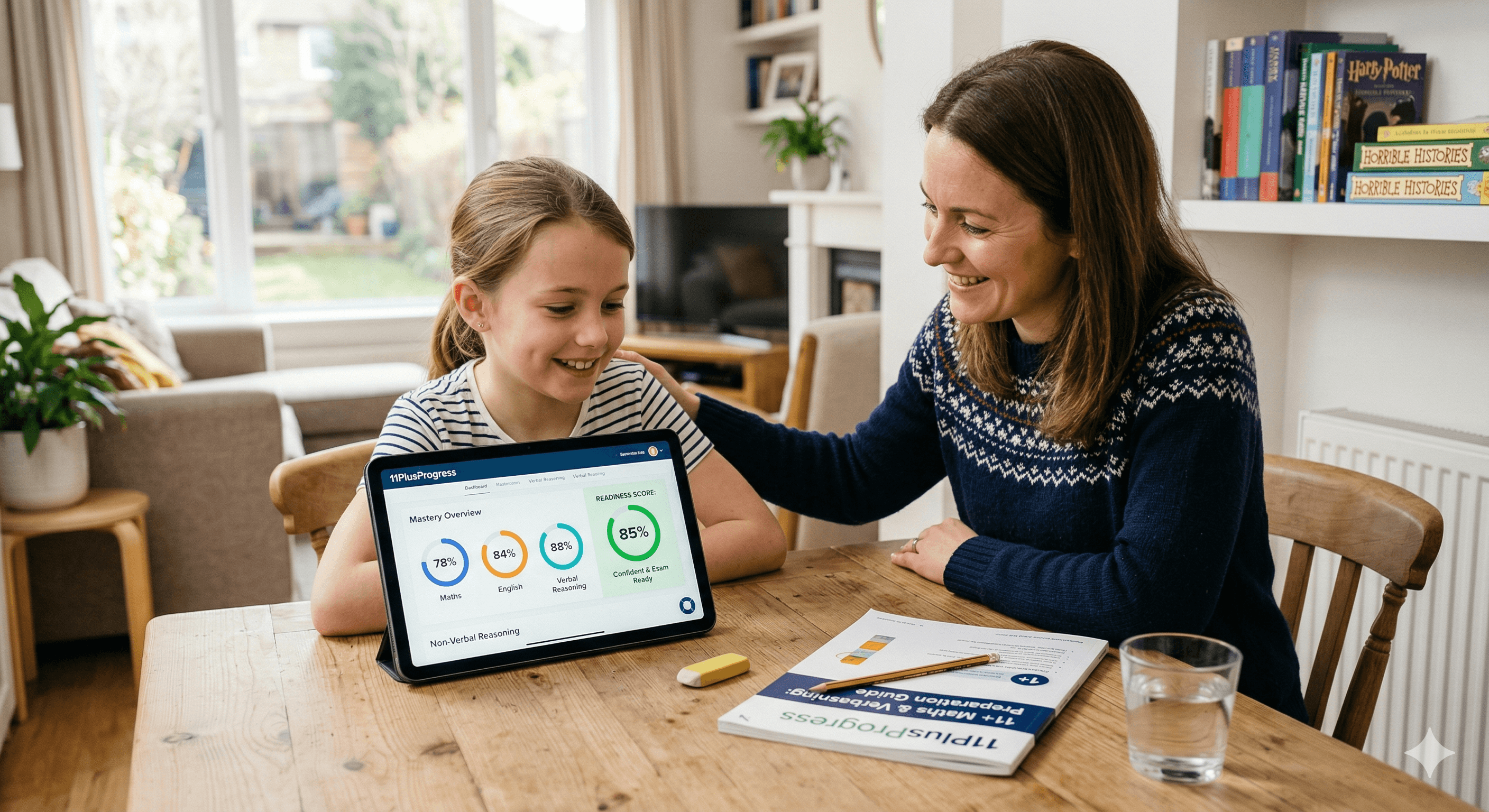
The 11+ exam represents one of the most significant crossroads in the British educational landscape, serving as the primary selective mechanism for entry into the United Kingdom's 163 grammar schools. For parents of children aged 8 to 11, navigating this process is often described as a marathon that requires a sophisticated understanding of regional variations, psychometric testing styles, and rigorous academic preparation. In 2026, the competition for places remains historically high, with some schools reporting up to eight applicants for every single available seat, necessitating a data-driven approach to preparation.
At its core, the 11+ is an entrance examination taken by primary school pupils in the autumn term of Year 6, typically when they are 10 or 11 years old. Its objective is to identify students who fall within the top 20% to 25% of the academic ability range, ensuring they are placed in state-funded grammar schools that offer an accelerated and highly academic curriculum. While the exam is exclusively used in England, its implementation varies dramatically between counties, with different regions employing distinct exam boards such as GL Assessment or bespoke regional papers.
This guide serves as a technical and practical roadmap for parents, deconstructing the complexities of the 2026 admissions cycle. By understanding the underlying mechanics of age-standardisation, the nuances of verbal and non-verbal reasoning, and the critical importance of tracking readiness, families can transition from a state of overwhelm to one of structured, confident preparation.
The Regional Landscape: Navigating the 2026 Consortia
The 11+ is not a unified national exam; rather, it is a localized assessment governed by local authorities or groups of schools known as consortia. This decentralization means that the subjects tested, the length of the papers, and the "pass" thresholds differ significantly depending on where a child resides.
Key Regions and Their Testing Frameworks
In the 2026 cycle, the move toward GL Assessment as the primary provider has solidified across most major regions. However, parents must remain vigilant about the specific requirements of their target schools, as even within a single county, individual schools may opt for bespoke assessments.
| Region / Consortium | Primary Exam Board (2026) | Testing Window | Subjects Tested |
|---|---|---|---|
| South West Herts Consortium | GL Assessment | Early September | Verbal Reasoning, Mathematics |
| Kent (Kent Test) | GL Assessment | Early September | English, Maths, Verbal Reasoning, Non-Verbal Reasoning, Spatial Reasoning |
| Buckinghamshire | GL Assessment | Early September | English, Maths, Verbal Reasoning, Non-Verbal Reasoning |
| West Midlands Consortium (Birmingham, Warwickshire, Shropshire, Walsall, Wolverhampton) | GL Assessment | Early September | English, Maths, Verbal Reasoning, Non-Verbal Reasoning |
| Essex (CSSE) | Bespoke (CSSE) | Late September | English (including Creative Writing), Mathematics |
| Sutton (SET) | Bespoke / Multi-Stage | Mid September | Stage 1: English & Maths (MC). Stage 2: English & Maths (Standard). |
| Bexley | GL Assessment | Early September | English, Maths, Verbal Reasoning, Non-Verbal Reasoning |
| Medway | GL Assessment | Mid September | English (Creative Writing), Mathematics, Verbal Reasoning |
| Slough Consortium | GL Assessment | Mid September | English, Maths, Verbal Reasoning, Non-Verbal Reasoning |
| Trafford Consortium | GL Assessment | Mid September | English, Maths, Verbal Reasoning, Non-Verbal Reasoning |
| Wirral Consortium | GL Assessment | Mid September | English, Maths, Verbal Reasoning, Non-Verbal Reasoning |
| Gloucestershire | GL Assessment | Mid September | English, Maths, Verbal Reasoning, Non-Verbal Reasoning |
| Lincolnshire | GL Assessment | Mid September | Verbal Reasoning, Non-Verbal Reasoning |
| Kingston & Sutton (Tiffins) | Bespoke / Multi-Stage | Oct / Nov | Stage 1: English & Maths. Stage 2: English (Writing) & Maths. |
| Redbridge | GL Assessment | Mid September | English, Maths, Verbal Reasoning, Non-Verbal Reasoning |
| Barnet (QE Boys, Henrietta Barnett) | GL / Bespoke | Early September | English, Mathematics (HB has a second stage in Oct) |
| Wiltshire (Salisbury) | GL Assessment | Late September | English, Maths, Verbal Reasoning, Non-Verbal Reasoning |
| Plymouth & Torbay | GL Assessment | September | English, Mathematics |
| North Yorkshire (Ripon) | GL Assessment | September | Verbal Reasoning, Mathematics |
| Northern Ireland (SEAG) | SEAG (Bespoke) | Nov / Dec | English (Gaeilge available), Mathematics |
The regional diversity is perhaps most evident in the exclusion of certain subjects. For instance, the Buckinghamshire Secondary Transfer Test focuses heavily on reasoning skills—Verbal, Non-Verbal, and Spatial—to assess potential rather than just curriculum knowledge. Conversely, the CSSE (Consortium of Selective Schools in Essex) utilizes two 60-minute written papers in English and Mathematics, eschewing reasoning entirely. Understanding these regional nuances is the first step in avoiding the common mistake of "preparing for the wrong exam".
The Competitive Reality of 2026
The demand for grammar school places continues to outstrip supply, particularly in areas like Gloucestershire and the London boroughs. Recent data indicates that in Gloucestershire, approximately 3,130 children sat the exam for 1,050 available places, resulting in a 1-in-3 chance of securing a spot. In highly selective institutions like Pate’s Grammar School, the odds can tighten to 1-in-10, as they may only qualify the top 250 applicants from a pool of over 2,500. This competitive pressure underscores the necessity for parents to look beyond simple curriculum mastery and focus on exam technique and speed.
Deconstructing Exam Boards: GL Assessment vs. CEM
The "exam board" refers to the organization that writes the test papers and, in many cases, marks them. For the 2026 cycle, the two names most parents will encounter are GL Assessment and CEM, though their roles have shifted significantly in recent years.
GL Assessment: The Industry Standard
GL Assessment (formerly NFER) is the most widely used provider in the UK. Their exams are known for their consistent, predictable structure, which favors students who have engaged in systematic, topic-based practice.
- Format: Almost exclusively multiple-choice. Students receive a question booklet and a separate OMR (Optical Mark Recognition) answer sheet.
- Predictability: GL provides a known universe of 21 question types for Verbal Reasoning, allowing students to master specific logic puzzles.
- Subjects: Typically tests English, Maths, Verbal Reasoning, and Non-Verbal Reasoning as four distinct papers.
- Scoring: There is no negative marking, meaning students are encouraged to attempt every question, even if guessing is required.
CEM (Centre for Evaluation and Monitoring)
Historically, CEM was the primary competitor to GL, favored by schools for its "tutor-proof" design. CEM papers were designed to be unpredictable, often mixing different subjects within a single timed section.
- The 2023-2026 Shift: In late 2022, CEM announced a pivot toward digital-only testing (CEM Select). Consequently, many grammar schools that previously used CEM’s paper-based exams have switched back to GL Assessment for the 2024–2026 seasons.
- Legacy Impact: Even schools that have moved away from CEM often retain a "CEM-style" approach, prioritizing a very high level of vocabulary and rapid reading comprehension over rote learning.
ISEB and Independent School Pre-Tests
For parents considering independent (private) schools, the ISEB Common Pre-Test is a crucial hurdle. Unlike the paper-based grammar school exams, the ISEB is a digital, adaptive test. If a child answers correctly, the subsequent question becomes more difficult; if they struggle, it becomes easier. This format requires a deep understanding of core concepts rather than just speed-reading through easy questions.
Subject Analysis: What Your Child Actually Needs to Know
The 11+ assesses four pillars of academic ability. While two (English and Maths) are curriculum-based, the other two (Verbal and Non-Verbal Reasoning) are often entirely new to students.
1. Mathematics: Beyond the Year 6 Classroom
The 11+ Maths exam is theoretically based on the Key Stage 2 National Curriculum, but it includes significant challenges that exceed standard classroom expectations. In most regions, the exam occurs in September of Year 6, meaning children are tested on Year 6 content they may not have yet learned in school.
| Mathematical Domain | Specific 11+ Requirements |
|---|---|
| Number Sense | Place value up to 1,000,000, Roman numerals, and prime numbers up to 100. |
| Arithmetic | Rapid recall of times tables up to 12x12, long division, and multi-step word problems. |
| Fractions/Decimals | Converting between fractions, decimals, and percentages; multiplying proper fractions by whole numbers. |
| Geometry | Properties of 3D shapes, calculating angles in a triangle, and symmetry/reflections. |
| Algebra | Solving simple equations (e.g. 2x + 5 = 17) and understanding number patterns. |
| Measurement | Converting metric to imperial units and calculating the volume of cubes and cuboids. |
The real difficulty in 11+ Maths lies in "multi-step" problems where a student must perform three or four distinct operations to find a single answer. Identifying which operation to use first is a core skill that must be practiced.
2. English: The Inference and Vocabulary Trap
English in the 11+ is more than just reading; it is about technical precision and deep comprehension.
- Comprehension: Students must move beyond "literal" retrieval (finding an answer in the text) to "inference" (understanding what the author implies). In 2026, many GL papers include classic 19th-century literature extracts, which use archaic vocabulary that can trip up even advanced readers.
- Technical Literacy: Exams test spelling, punctuation, and grammar (SPaG) through "Spot the Error" or cloze passages where a child must select the correct word to complete a sentence.
- Vocabulary: This is the single biggest predictor of 11+ success. Words like "obstinate," "gregarious," or "melancholy" frequently appear in synonyms and antonyms sections.
3. Verbal Reasoning: The Logic of Language
Verbal Reasoning (VR) tests a child's ability to use logic to solve problems with words and numbers. Since it is not taught in the National Curriculum, many children find it "mind-bending" at first.
GL Assessment typically draws from a pool of 21 question types. Mastery of these specific puzzles is essential for speed.
- Making Words: "Hidden Word" (finding a four-letter word hidden between two others) and "Move a Letter" (moving one letter from one word to another to make two new words).
- Codes: Replacing letters with numbers to decode a secret word.
- Word Meanings: Identifying "Odd One Out" or finding "Closest Meanings" (synonyms).
- Maths-based VR: Number series and "Letters for Numbers" sums.
4. Non-Verbal and Spatial Reasoning: Visual Intelligence
Non-Verbal Reasoning (NVR) involves identifying patterns in shapes and diagrams. Spatial Reasoning is a subset of NVR that focuses on 3D manipulation.
- 2D NVR: Patterns, shape analogies, rotations, and reflections.
- Spatial Reasoning: This is becoming more common in GL exams. It includes "Nets and Cubes" (visualizing which 3D cube a 2D net will form) and "3D Shapes from Above" (identifying the plan view of a block structure).
- The Visual Advantage: NVR is designed to be "culture-fair," meaning it tests innate logic rather than learned English vocabulary, though it still requires significant practice to master the "rules" of shape movement.
Standardisation and Pass Marks: The Math Behind the Results
One of the most frequent sources of parental anxiety is the "pass mark." Unlike a school spelling test where 80% is a clear pass, the 11+ uses Age-Standardised Scores (SAS).
Understanding the SAS Formula
The purpose of standardisation is to ensure fairness across a cohort where children may be up to 12 months apart in age. Research shows that a child born in September typically has a larger vocabulary and better cognitive stamina than a child born in the following August.
The standardisation process takes three variables into account:
- Raw Score: The number of questions answered correctly.
- Test Difficulty: If the 2026 paper is harder than the 2025 paper, the SAS is adjusted upward.
- Age: The child’s age in years and months at the time of the exam.
The scores are mapped to a bell curve where:
- 100 is the statistical average.
- 111-121 is the typical qualifying threshold for many grammar schools.
- 142 is generally the maximum possible score.
For example, in Buckinghamshire, a child needs an SAS of 121 or above to qualify. In Kent, the threshold is often an aggregate score of 332, with no individual paper (English, Maths, or Reasoning) falling below a specific mark, such as 109.
Competition and "Cut-off" Scores
In regions where schools are heavily oversubscribed, reaching the qualifying mark (e.g., 121) is only the first step. Schools then rank students by their score. A school might have 150 places and 500 children who "passed." In this scenario, the school will offer places to the 150 highest-scoring children. This is why aiming for the "minimum pass" is rarely enough; students should aim for the top 10% of the cohort (an SAS of 120+).
The 2026 Preparation Timeline: From Year 4 to Year 6
Success in the 11+ is rarely the result of "cramming." Experts recommend a structured 12-to-18-month preparation window.
Year 4: The Foundation Phase (Ages 8–9)
The goal in Year 4 is not to do 11+ papers, but to build the cognitive foundations.
- Reading: Encourage reading of challenging fiction and non-fiction for at least 20 minutes a day.
- Mental Maths: Ensure rapid-fire recall of all times tables up to 12x12.
- Introduction to Reasoning: Use puzzles, crosswords, and logic games to build "flexible thinking".
- Baseline Testing: Conduct a light assessment to see where your child naturally sits without any coaching.
Year 5: The Intensive Phase (Ages 9–10)
This is the most critical year. Most families begin formal 11+ work in the January of Year 5.
- Term 1 (Sept–Dec): Introduce Verbal and Non-Verbal Reasoning question types one by one. Do not worry about time limits yet; focus on accuracy.
- Term 2 (Jan–April): Complete the KS2 Maths curriculum. Ensure topics like ratios, algebra, and area/perimeter are rock solid.
- Term 3 (May–July): This is the registration window. Start introducing timed sections. A 10-minute test is more effective than a 2-hour slog.
- Summer Holidays: Introduce full-length mock exams. These should be used to build "exam stamina" and refine time-management strategies like the "mark and move" technique.
Year 6: The Final Sprint (Ages 10–11)
- September: The exam itself. Keep the atmosphere calm. Focus on well-being, sleep, and hydration.
- October: Results are released.
- October 31st: The deadline for the Common Application Form (CAF). You must list your grammar school choices here after you have received your 11+ results.
10 Common Mistakes Parents Make (And How to Avoid Them)
Drawing from years of consultancy, we have identified the most frequent traps that lead to 11+ failure.
- Starting Too Late: Trying to cram the entire reasoning curriculum into the six weeks of summer before Year 6 leads to burnout and high anxiety.
- Focusing Only on Practice Papers: Papers tell you how your child is doing, but they don't teach the concepts. Spend 80% of your time on learning and 20% on testing.
- Ignoring the Wrong Exam Board: Parents often buy "Bond Books" or "CGP" without checking if they match the GL or CEM format of their local school. This is a waste of time.
- Creating Too Much Pressure: The 11+ is an "optional" exam. If a child feels their whole future depends on one Saturday in September, they are likely to panic on exam day.
- Neglecting Reading: You cannot "tutor" a child to have a great vocabulary in three months. It is built through years of reading high-quality books.
- Long Study Sessions: A child's concentration drops after 30 minutes. Four 20-minute sessions across a week are far more effective than a 4-hour session on a Saturday morning.
- Ignoring Weak Areas: Children (and parents) naturally prefer to practice what they are already good at. True progress only happens when you target the "scary" topics.
- Not Simulating Exam Conditions: If a child always does practice at the kitchen table with snacks and music, the silence of a formal exam hall can be terrifying.
- Teaching the "Wrong" Methods: Parents often teach long division or algebra using the methods they learned 30 years ago, which can confuse children who are taught modern methods in school.
- Comparing Progress with Others: Every child has a different learning curve. Focus on your child's individual data, not the "toxic" gossip of playground or Facebook groups.
How to Track Your Child’s Readiness Effectively
The "Ready or Not?" question is what keeps parents awake at night. In the past, this was a guessing game based on the scores of a few practice papers. In 2026, technology allows for a much more sophisticated, data-driven approach.
The Problem with Traditional Marking
If your child gets 80% on a maths paper, that sounds great. But what if that 20% they missed was entirely composed of "Fractions"? On the real exam day, if the paper is heavy on fractions, their score will plummet. Traditional marking hides these "topic gaps."
Using Data to Spot Gaps Early
To track readiness effectively, you must break the 11+ down into its constituent parts. This is where a platform like 11PlusProgress becomes invaluable.
- Topic-Based Breakdown: Instead of general "Maths," look for performance data on specific areas like Ratios, Geometry, or Prime Numbers.
- Speed vs. Accuracy Analysis: A child might be 100% accurate but 50% too slow. Tracking the "time per question" identifies where a child is over-thinking.
- Adaptive Learning: Use tools that adjust the difficulty of the questions based on the child's performance. This ensures they are always challenged but never demoralized.
- The "Weak Area" Dashboard: A digital dashboard that automatically pulls out the topics where your child is struggling allows you to plan your next week of study in seconds rather than hours.
Check your child's progress
Open the parent dashboard for topic breakdowns, history, and next steps after practice.
Check your child's progressConversion Strategy: Why 11PlusProgress?
As an EdTech strategist, I’ve seen hundreds of platforms. Most fail because they are just digital versions of boring workbooks. 11PlusProgress is different because it is built around the "intentional practice" model.
Organized Practice for Busy Parents
Most families don't struggle because of a lack of effort; they struggle because practice isn't organized. 11PlusProgress solves this by:
- Curated Question Sets: You don't have to wonder what to study next. Choose a topic (e.g., "Compound Words" or "Long Division") and get a focused set of questions that mirror the 2026 GL Assessment format.
- Independent Learning: The platform provides step-by-step solutions for every question. This means your child can learn from their mistakes immediately, without waiting for you to finish work and mark their paper.
- Multi-Device Access: Start a session on a laptop and finish it on a tablet in the car. It makes fitting 20 minutes of daily practice into a busy UK lifestyle possible.
Final Conclusion: The Road to September 2026
The 11+ exam is undeniably a rigorous challenge, but it does not have to be a source of family trauma. By understanding the regional landscape, mastering the specific question types of the GL Assessment board, and using data to track progress, you can turn a daunting hurdle into a structured academic achievement.
The key to success in the 2026 cycle is consistency over intensity. Ten minutes of focused, topic-based practice every day is worth more than a dozen hours of "bulk testing" in August. By identifying your child's weak areas early and addressing them with high-quality, targeted resources, you give them the best possible chance to walk into that exam hall with confidence and clarity.
Start free
Create an account and begin structured 11+ practice. Free during public beta — see our Terms.
Sign up free