
Step-by-Step Blueprint for 11+ Success: A Three-Year Roadmap
A structured Year 4–6 plan for 11+ preparation: GL vs CEM, subject focus, mocks, spaced revision, and how to spot when a child needs support—plus how to track progress calmly.
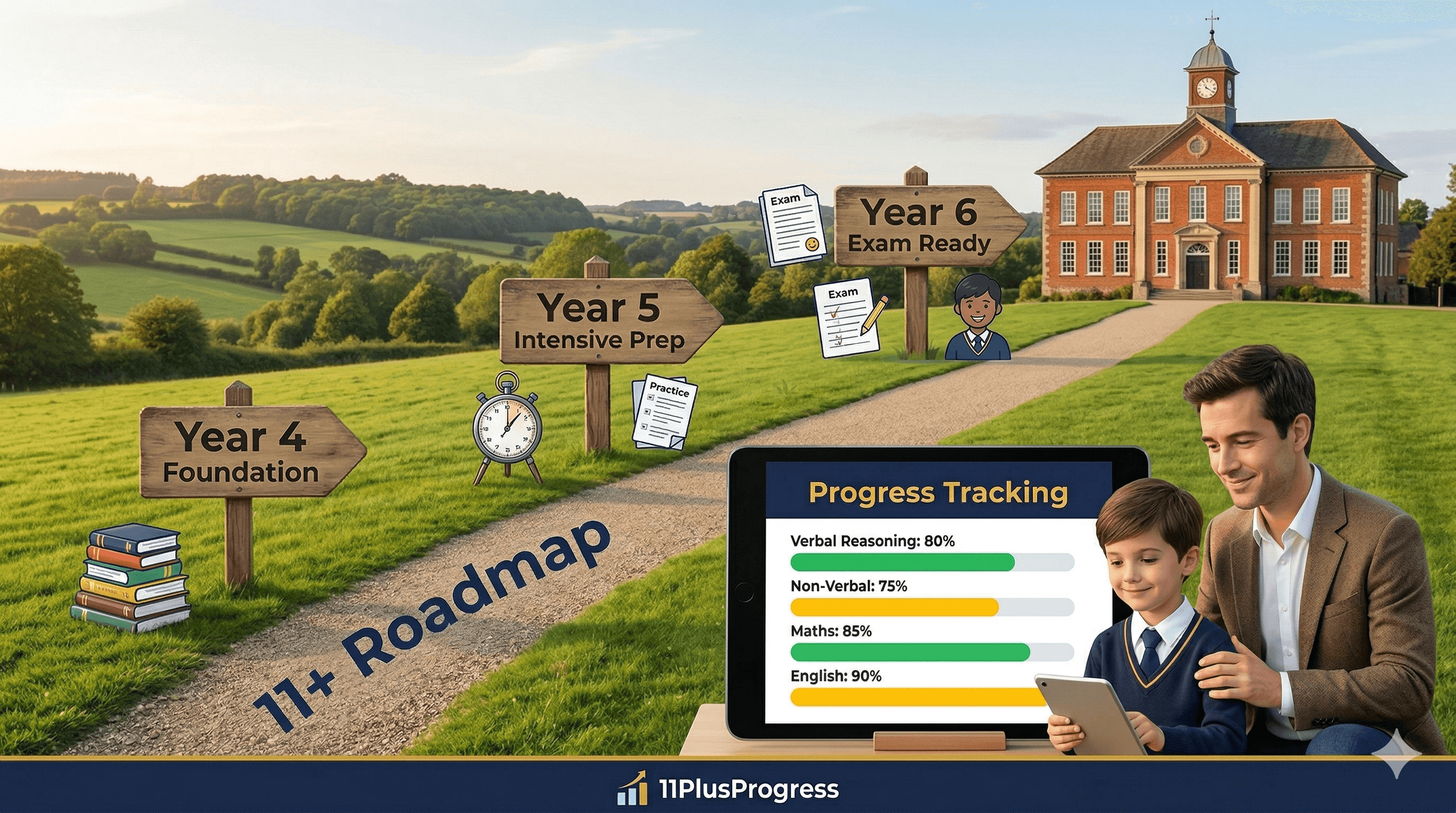
The 11+ examination represents a critical juncture in the United Kingdom's educational system, acting as the primary mechanism for selection in grammar schools and many high-achieving independent institutions. For parents navigating this landscape, the challenge is not merely one of academic content but of strategic orchestration. Success in the 11+ requires a transition from passive school-based learning to a proactive, data-driven preparation model that aligns cognitive development with the rigorous demands of examination boards. This report provides an exhaustive roadmap for families embarking on this three-year journey, integrating pedagogical best practices with technological tools like 11PlusProgress to ensure optimal outcomes.
The Macro Landscape: Examination Boards and Regional Variations
The 11+ environment is characterized by significant regional diversity, primarily dictated by the presence of two dominant examination boards: GL Assessment and the Centre for Evaluation and Monitoring (CEM). As of the 2023–24 academic season, a notable shift occurred where the majority of UK grammar school consortiums, including those in Birmingham and Lincolnshire, transitioned back to GL Assessment. This return to a more standardized reasoning-based format has implications for how content must be prioritized.
Comparison of Core Examination Providers
The choice of examination board dictates the structure of the test papers and the required focus of the revision cycle. The following table delineates the primary differences that the analysis indicates are essential for parental planning.
| Feature | GL Assessment | CEM (Traditional & Digital) |
|---|---|---|
| Question Format | Predominantly multiple-choice with clear subject separation. | Often integrated papers with mixed question types and high time pressure. |
| Content Scope | Comprehensive coverage of English, Maths, Verbal Reasoning, and Non-Verbal Reasoning. | Heavy emphasis on vocabulary, numerical reasoning, and "tutor-proof" unpredictability. |
| Scoring Mechanism | Raw scores are converted into Standardised Age Scores (SAS) to ensure fairness for younger children. | Focuses on speed and rapid cognitive processing, often with shorter timed sections. |
| Regional Dominance | Buckinghamshire, Kent, Lincolnshire, and the majority of national grammar schools. | Used by specific regions and independent schools trialling digital adaptive formats. |
The standardization process is a fundamental aspect of the 11+ scoring system. Raw scores are adjusted to account for the exact age of the student at the time of the test, typically ranging from 60 to 142, with 100 representing the mean performance for the year group. This mechanism ensures that a child born in August is not at a competitive disadvantage compared to a child born in September of the previous year.
Phase I: The Year 4 Acceleration Zone (Foundation Building)
The consensus among 11+ specialists is that formal preparation should ideally begin approximately 18 to 24 months before the exam date. Year 4 is categorized as the foundation phase, where the objective is to cultivate academic fluency and a robust work ethic without the psychological pressure of formal mock testing.
Strategic Objectives for Year 4
At this stage, the focus remains on the core National Curriculum, with targeted extensions to prepare for the specific challenges of the 11+.
- Linguistic Expansion: Research indicates that a broad vocabulary is the single most important predictor of success in both English and Verbal Reasoning. Children should be encouraged to read widely across fiction and non-fiction, encountering "unusual" language such as abhorrent, impeccable, and jocular.
- Numerical Fluency: Mastery of times tables up to 12×12 is non-negotiable. Furthermore, children must be confident in the four operations—addition, subtraction, multiplication, and division—to the point where mental arithmetic does not consume cognitive load during complex problem-solving.
- Reasoning Introduction: Non-Verbal Reasoning (NVR) and Verbal Reasoning (VR) are rarely taught in the standard primary curriculum. Year 4 should introduce these as "puzzles" to foster curiosity rather than "tests" to build anxiety.
Weekly Year 4 Study Structure
The recommended approach in Year 4 is "little and often," aiming for 30-minute sessions approximately two to three times per week.
| Session Type | Activity Focus | Strategic Benefit |
|---|---|---|
| The Reading Hour | 20 minutes of daily active reading (fiction/non-fiction). | Builds stamina and contextual vocabulary understanding. |
| Maths Drills | 15 minutes of mental arithmetic and times tables practice. | Enhances processing speed for later multi-step problems. |
| The Puzzle Session | Introduction to simple pattern sequences and word games like Boggle or Scrabble. | Develops the logical "brain muscles" required for NVR and VR. |
Phase II: The Year 5 Full Speed Ahead (Intensive Preparation)
Year 5 is the critical period where the vast majority of the 11+ syllabus is mastered. The curriculum shifts from general academic support to specific exam-oriented strategies, including time management and multiple-choice technique.
The Year 5 Syllabus: Subject Deep-Dives
Mathematics: Extending the KS2 Curriculum
The 11+ Maths exam requires a child to handle approximately 100 subtopics, many of which are not introduced in school until the end of Year 6. Mastery must be achieved across number theory, geometry, and data handling.
| Module | Key Subtopics for Mastery | High-Level Skills Required |
|---|---|---|
| Number Theory | Factors, multiples, prime numbers, HCF/LCM, and BIDMAS. | Rapid identification of number properties to simplify calculations. |
| FDP | Conversion between fractions, decimals, and percentages; percentages of amounts. | Solving multi-step word problems involving financial or quantity changes. |
| Geometry | Angles in triangles/quadrilaterals, 3D shape properties, nets, and transformations. | Spatial reasoning and the ability to mentally rotate or reflect objects. |
| Algebra | Simple one-step equations, substitution, and x term sequences. | Translating word problems into mathematical expressions. |
| Measurement | Area and perimeter of compound shapes, volume of cuboids, and time/distance calculations. | Unit conversion (metric to imperial) and interpretation of timetables. |
English: The Art of Inference
The English component demands a shift from literal comprehension to inferential analysis. GL Assessment English papers often feature long fiction or non-fiction passages followed by questions that test the child’s ability to "read between the lines".
- Inference and Deduction: The child must identify a character's emotional state or the author's intent based on subtle linguistic cues.
- Vocabulary in Context: Rather than simple definitions, the exam tests the ability to determine a word's meaning based on its usage within a paragraph.
- Technical English: This includes identifying word classes (nouns, verbs, adjectives), correcting punctuation errors, and recognizing grammatical structures like the passive voice.
Verbal and Non-Verbal Reasoning: The Logic Core
Reasoning tests assess raw potential and cognitive agility. Verbal Reasoning involves 21 distinct question types, ranging from letter-coding puzzles to word analogies. Non-Verbal Reasoning requires the child to identify patterns in shapes, such as identifying the "odd one out" or completing a matrix of changing diagrams.
Year 5 Operational Timetable
In Year 5, the intensity increases to 4-6 hours per week, typically broken down into daily sessions of 45-60 minutes.
| Day | Subject Focus | Specific Activity |
|---|---|---|
| Monday | English | Reading comprehension passage + identifying metaphors/similes. |
| Tuesday | Mathematics | Topic-based drills (e.g., Ratio and Proportion). |
| Wednesday | Verbal Reasoning | 15 minutes of vocabulary expansion + 30 minutes of VR question types. |
| Thursday | Non-Verbal | Visual puzzle practice focusing on rotation and symmetry. |
| Friday | Revision | Reviewing all incorrect answers from the previous four days. |
| Saturday | Mock / Timed | A light timed practice session to build speed. |
| Sunday | Rest | Recharging is vital for long-term retention. |
Phase III: The Year 6 Finish Line (Exam Readiness)
The 11+ exam is typically taken in the first two weeks of September in Year 6. This leaves very little time after the summer holidays, meaning the "heavy lifting" must be completed by the end of Year 5. Year 6 is the phase of refinement, stamina building, and psychological preparation.
The Role and Timing of Mock Exams
Mock exams are an essential tool for identifying performance plateaus and desensitizing children to exam pressure. However, their introduction must be strategic to avoid early burnout.
- Year 5 Spring Term: Begin formal mock exams once every 4-6 weeks to introduce the concept of a timed, formal environment.
- Year 5 Summer Term: Increase frequency to once per month. The focus should shift from "finding the right answer" to "managing the clock".
- Summer Holidays (July/August): Increase frequency to one mock per week. This builds the academic stamina required to maintain focus for two one-hour papers on exam day.
- Year 6 (Late August): Conduct one final "victory" mock to boost confidence, followed by a tapering period of light revision.
Cognitive Science and Revision: The Pedagogy of Success
Effective 11+ preparation is not about the volume of hours spent; it is about the quality of the cognitive processing during those hours. Expert content strategies prioritize active learning over passive reading.
The 2-3-5-7 Spaced Repetition Method
Spaced repetition is a scientifically proven technique to combat the "forgetting curve". By reviewing a topic at strategic intervals, information is transferred from short-term to long-term memory.
- Immediate Review: Summarize the topic immediately after learning.
- Day 2: Use active recall (testing without notes) to retrieve the information.
- Day 5: Complete practice questions related to the topic.
- Day 10: Integrate the topic into a mixed-subject revision session.
Interleaving and Active Recall
Interleaving involves mixing different subjects or question types within a single study session. For example, instead of doing 40 questions on "Fractions," a child might do 10 on Fractions, 10 on Punctuation, 10 on Non-Verbal Matrices, and 10 on Synonyms. This forces the brain to constantly "switch gears," mirroring the reality of the 11+ exam where multiple skills are tested in rapid succession.
Identifying Obstacles: Signs Your Child is Falling Behind
The 11+ journey is rarely linear. It is common for children to hit performance plateaus or experience emotional resistance. Identifying these "red flags" early allows for corrective action before the gaps become insurmountable.
Behavioral and Academic Red Flags
| Category | Indicator | Underlying Cause |
|---|---|---|
| Homework Resistance | Daily battles, tears, or extreme procrastination over simple tasks. | Often signals a lack of foundational understanding, making the task feel overwhelming. |
| The "Memory Gap" | A child seems to "forget everything" they learned in a previous session. | Indicates that the information was memorized by rote rather than conceptually understood. |
| Time Discrepancy | A 15-minute task consistently takes over 45 minutes to complete. | Suggests either a lack of processing speed or a struggle with the underlying subject matter. |
| Score Stagnation | Practice paper scores remain the same for several months despite regular study. | Usually means the child is only practicing what they already know and avoiding weak spots. |
| Physical Symptoms | Sudden headaches, stomach aches, or changes in sleep patterns before study. | These are physiological manifestations of performance anxiety and burnout. |
Strategy for Correction
When these signs appear, the recommended strategy is to "regress to progress". This involves reducing the difficulty of the material to rebuild confidence, shortening study sessions to 15-20 minutes to reduce cognitive load, and focusing on positive reinforcement rather than punitive measures.
The Technological Edge: Using 11PlusProgress to Navigate the Journey
Modern 11+ preparation has evolved beyond static workbooks. In a competitive environment where only the top 20-25% of students achieve grammar school placement, the ability to use data-driven insights is a significant differentiator. 11PlusProgress is designed to act as a digital compass for this multi-year journey.
Precision Tracking and Weak Area Identification
One of the most common pitfalls in home-based preparation is the "echo chamber" effect—where children focus on subjects they enjoy and avoid those they find difficult. The 11PlusProgress parent dashboard solves this by providing granular performance reports.
- Topic Mastery Levels: The platform identifies exactly which of the 100+ Maths topics or 21 Verbal Reasoning types a child has mastered and where they are underperforming.
- Time Analysis: 11+ success is as much about speed as accuracy. 11PlusProgress tracks how long a child takes on each individual question, identifying areas where slow processing might hinder their overall score.
- Progress Visualization: Visual charts allow parents to see if their child’s score trajectory is moving upward or if they have hit a plateau that requires intervention.
Adapting to the 2025 and 2026 Trends
Current trends in the 11+ indicate an increasing emphasis on critical thinking and "digital literacy" as some boards trial online adaptive formats. By using a digital platform like 11PlusProgress, children become accustomed to reading on screens, using online interfaces, and managing digital time constraints—skills that are becoming increasingly relevant as the assessment landscape evolves.
Administrative and Strategic Milestones
The 11+ process is governed by strict local authority deadlines. Failure to adhere to these can result in a child being unable to sit the exam, regardless of their level of preparation.
| Date | Milestone | Parent Action |
|---|---|---|
| Year 5 May/June | Registration Opens | Parents must register their child for the 11+ with their local consortium. |
| Year 5 June/July | Grammar School Open Days | Visit potential schools to narrow down preferences for the CAF form. |
| Year 6 September | The 11+ Exam | Typically two papers (often Verbal/English and Maths/Non-Verbal). |
| Year 6 October | Results Day | Results are received, providing the Standardised Age Score. |
| Year 6 October 31 | CAF Deadline | Submission of the Secondary School Preference Form to the local council. |
| Year 6 March 1 | National Offer Day | Confirmation of the child’s secondary school placement. |
Final Strategic Summary for Parents
Successful 11+ preparation is not an act of luck; it is an act of engineering. By viewing the process as a three-year roadmap rather than a final-year sprint, parents can manage the cognitive and emotional load on their children.
The transition from the foundational curiosity of Year 4 to the intensive mastery of Year 5 requires a shifting methodology—from play-based logic to timed, strategic drills. Throughout this process, the role of the parent is to remain the "Chief Emotional Officer," providing a stable environment where mistakes are viewed as data points for improvement rather than personal failures.
To begin this journey with clarity, parents are encouraged to move away from the guesswork of manual tracking. 11PlusProgress offers the tools necessary to identify skill gaps immediately, ensuring that every minute of study time is optimized for the actual requirements of the GL and CEM boards. By using 11PlusProgress’s free access, parents can baseline their child’s current performance and begin the step-by-step plan with the confidence that they are tracking progress toward a successful grammar school entry.
Start free
Create an account and begin structured 11+ practice. Free during public beta — see our Terms.
Sign up freeCheck your child's progress
Open the parent dashboard for topic breakdowns, history, and next steps after practice.
Check your child's progress