
Is Your Child Ready for the 11+? Key Signs to Look For
How to judge 11+ readiness: English, maths, and reasoning benchmarks, emotional resilience, timing and tactics, GL vs CEM, a parent checklist, and how data and SAS scores help you prepare with confidence.
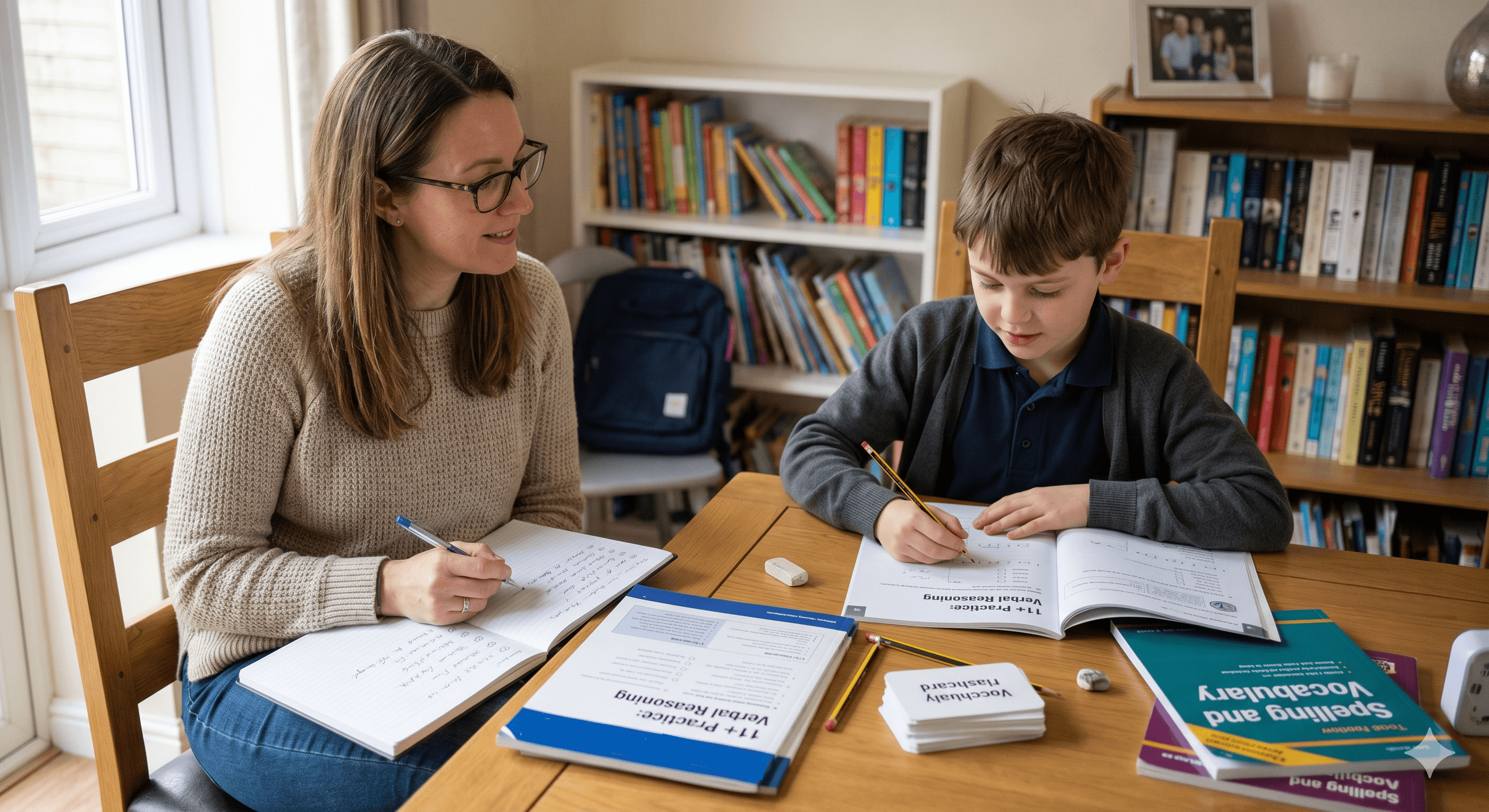
The 11 Plus examination is a major milestone in the UK: for many families it is the route into selective grammar schools and some independent schools. For parents of children roughly aged eight to eleven, judging readiness is more than a single school report—it spans academic skill, stamina, emotional resilience, and how well a child can work under time pressure.
This article walks through practical signs of 11+ readiness: what “ready” tends to look like in English, maths, and reasoning; how behaviour and mindset show up on the day; and how exam technique and board differences (GL Assessment vs CEM-style papers) affect what you should prioritise. The aim is a clear framework you can use at home, not a single score or label.
Most parents only see where a child is truly struggling once they sit a full mock under exam conditions. Spotting weak areas early—with topic-level accuracy and pacing, not just a percentage at the top of a paper—makes preparation more targeted and often less stressful. That is where a structured practice and tracking approach helps you focus effort where it moves the mark.
The academic foundations of 11 Plus readiness
Academic readiness for the 11+ is often described as working securely at least around the top of the primary band for the year group, with the speed and depth the exam expects on top of normal classroom work. The National Curriculum is the baseline; the 11+ usually asks for faster recall, wider vocabulary, and more multi-step problems than a typical week at school.
English proficiency and linguistic sophistication
For the 11+, English is not only “good reading and writing.” Papers typically assess reading comprehension, vocabulary range, grammar and punctuation, and sometimes creative writing, depending on your region and school.
Comprehension at this level includes challenging fiction, non-fiction, and poetry. A child who is well prepared can infer meaning (what is implied, not only what is stated), follow tone and viewpoint, and handle figurative language. Strong candidates usually read widely and often—not only school books—and notice new words in context.
Vocabulary underpins both English and Verbal Reasoning. Many successful families build words steadily over months (for example through reading, word lists, and short retrieval practice) rather than cramming near the test. In speech and writing, look for varied word choice and curiosity about unfamiliar words.
| English indicator | Readiness benchmark | Evidence of proficiency |
|---|---|---|
| Reading stamina | Around 30–45 minutes of focused silent reading | Can stay with a demanding text without losing the thread |
| Inference | Goes beyond literal retrieval | Identifies subtext, tone, and why an author chose a phrase |
| Vocabulary | Ongoing acquisition and review | Uses precise synonyms and understands antonyms in context |
| Grammar / punctuation | Secure KS2 expectations | Applies commas, apostrophes, and sentence variety accurately |
Mathematical mastery and numerical fluency
11+ maths spans arithmetic, word problems, geometry, data handling, and early algebra-style thinking. Readiness usually shows as quick, accurate number facts and the ability to select steps in longer problems without getting lost.
Times tables to 12×12 should be fluent enough that basic calculations do not consume all of the child’s attention in a timed paper. Many regions also expect comfort with topics that may arrive earlier on an 11+ paper than in school at the same moment—such as ratio, proportion, primes, and properties of shapes—so flexibility matters as much as “having seen it once.”
For a structured overview of what the exam can cover across subjects, see our complete 11+ guide for parents (2026). You can also browse practice topics on the platform to align work with the areas your child needs most.
Reasoning ability: the cognitive differentiator
Verbal and Non-Verbal Reasoning are central to many 11+ papers and are not always taught in depth at primary school, so first exposure can feel unfamiliar. They reward pattern spotting, systematic thinking, and speed.
Verbal Reasoning includes word logic, codes, analogies, and similar tasks. Non-Verbal and Spatial Reasoning focus on shapes, patterns, and visual sequences—often including nets, rotations, and “which shape comes next” style items. Readiness here is less about school topics and more about practising question types until approaches feel automatic.
Behavioural and emotional indicators of readiness
Academic level is necessary but not sufficient. The 11+ is sat once under pressure; children who can recover from mistakes and keep going tend to do better than those who unravel after one hard question.
Resilience and the response to failure
Watch how your child reacts when an answer is wrong. Frustration is normal early on; readiness often looks like treating errors as information—what to revise—rather than as a verdict on ability. Over time, that feeds calmer performance when a clock is running.
Independence and work ethic
Many families spread serious preparation over roughly twelve to eighteen months. A child who can work independently for stretches of around thirty to forty-five minutes (with age-appropriate breaks) is better matched to sustained practice than one who needs constant redirection for every question.
Intrinsic interest helps. If every session becomes a battle, it may be worth pausing to adjust pace, format, or expectations—not only “pushing harder”—so the process stays sustainable.
| Behavioural sign | Description of readiness | Long-term implication |
|---|---|---|
| Self-regulation | Stays relatively calm on hard questions | Reduces panic and “blanking” on the day |
| Stamina | Can focus on one subject for a typical paper segment | Matches real exam length better |
| Accountability | Takes ownership of small practice goals | Supports the study habits grammar schools expect |
| Curiosity | Wants to know why an answer is right or wrong | Deepens reasoning, not only marks |
Time management and tactical readiness
The 11+ is often as much about pacing as about raw knowledge. Children who spend too long on one item can lose marks they would have gained on easier questions later in the paper.
The “rough seconds per question” mindset
In many GL-style formats, papers pack many questions into forty-five to sixty minutes. Readiness includes knowing roughly how long an item can have—and when to move on. The “skip and return” habit (mark a tough question, answer easier ones, come back if time allows) is a core professional exam skill, not a shortcut.
Accuracy under pressure
Practice both untimed (to learn) and timed (to perform). Readiness shows when accuracy stays strong under time limits, not only at the kitchen table with no clock. If accuracy collapses as soon as a timer appears, build up gradually rather than jumping to full papers too soon.
Identifying why mistakes happen—knowledge gap, misread question, or time pressure—turns each practice session into a plan for the next. Platforms that break results down by topic and timing make that diagnosis much faster than marking a paper by hand alone.
Problem-solving and cognitive flexibility
Papers often include questions that look unfamiliar on purpose, especially in CEM-style or mixed-format assessments. The goal is to see whether a child can apply what they know in a new wrapper.
Multi-step logic
Readiness includes holding several facts in mind at once—multi-step word problems in maths, or inference that pulls different parts of a passage together in English.
Adaptability
Switching between maths, verbal, and non-verbal style thinking within a session mirrors many real papers. Children who can reset quickly between question types tend to cope better when sections are tightly timed.
Comparing exam board requirements: GL vs CEM
Your local authority or consortium chooses the format; “ready” for one board can emphasise slightly different habits.
| Feature | GL Assessment | CEM (Cambridge-style) |
|---|---|---|
| Syllabus | Often English, Maths, VR, NVR as separate papers | Often mixed skills within sections |
| Focus | Known VR types and repeatable techniques | Broad vocabulary and fast problem-solving |
| Time management | Pacing per subject paper | Short, intense bursts within sections |
| Preparation | Systematic topic and technique practice | Wide reading plus flexible thinking |
The 11 Plus readiness checklist: a comprehensive audit
Use this as a conversation starter—not a pass/fail list. Every child develops on a different curve.
Academic indicators
- Working securely at or above age expectations in school, with stretch in core English and maths where possible
- Comfortable discussing word meaning and using ambitious vocabulary in context
- Rapid, accurate recall of multiplication facts to 12×12 in mixed order
- Confident with fractions, percentages, and proportions in word problems
- Can explain implied meaning in a text, not only surface detail
Behavioural signs
- Can complete focused homework or practice for a realistic session length without constant supervision
- Bounces back from mistakes without a prolonged shutdown
- Shows curiosity about corrections rather than only the score
- Has a sustainable weekly routine rather than only occasional cramming
Cognitive and tactical skills
- Can finish a timed section without routinely running out of time
- Can explain reasoning in Verbal Reasoning, not only guess
- Comfortable with visual and spatial question styles where your board includes them
- Reads the question carefully before committing to an answer
How to objectively measure readiness using performance data
Checklists help, but the 11+ environment is different from a familiar classroom. The most reliable picture usually combines observation with performance data from realistic practice and, where relevant, standardised scores.
The importance of the Standardised Age Score (SAS)
Many 11+ processes do not use a simple percentage. Raw marks are often converted to a Standardised Age Score (or similar), placing a child relative to others with age taken into account—so summer-born children are not unfairly compared only to autumn-born peers without adjustment. An SAS of 100 is typically described as average; grammar schools often quote thresholds in SAS terms, and the most selective schools may imply higher bands—always check your target schools’ own guidance for the year you apply.
Tracking progress and identifying weak areas
A useful dashboard should help you see:
- Accuracy by topic — whether gaps are in a whole subject or specific areas (for example ratio vs geometry).
- Pacing — time per question or section, so you know if the issue is speed, carelessness, or knowledge.
- Retention — performance on a topic after a gap, to check it has stuck, not only been memorised for one night.
- Benchmark context — how performance compares to a large, realistic cohort, where the product provides it.
The diagnostic approach to preparation
Data-led practice means spending more time on the topics that move the score, and less on repeating work your child already owns. That tends to protect motivation and reduce burnout in the months before the exam. When progress is visible, confidence often follows—without pretending the test is easy.
Closing summary
Readiness for the 11+ is multidimensional: curriculum strength, reasoning skills, emotional steadiness, and exam habits all play a part. Boards and regions differ, so align preparation with your local format, then measure honestly with a mix of observation, timed practice, and topic-level feedback.
Start free
Create an account and begin structured 11+ practice. Free during public beta — see our Terms.
Sign up freeCheck your child's progress
Open the parent dashboard for topic breakdowns, history, and next steps after practice.
Check your child's progress