
11+ Maths Topics: The Definitive Guide to Helping Your Child Succeed
A complete, parent-friendly breakdown of 11+ maths topics (KS2 + stretch), the GL vs CEM vs independent differences, and the most common mistakes—plus how to find and fix weak areas early.
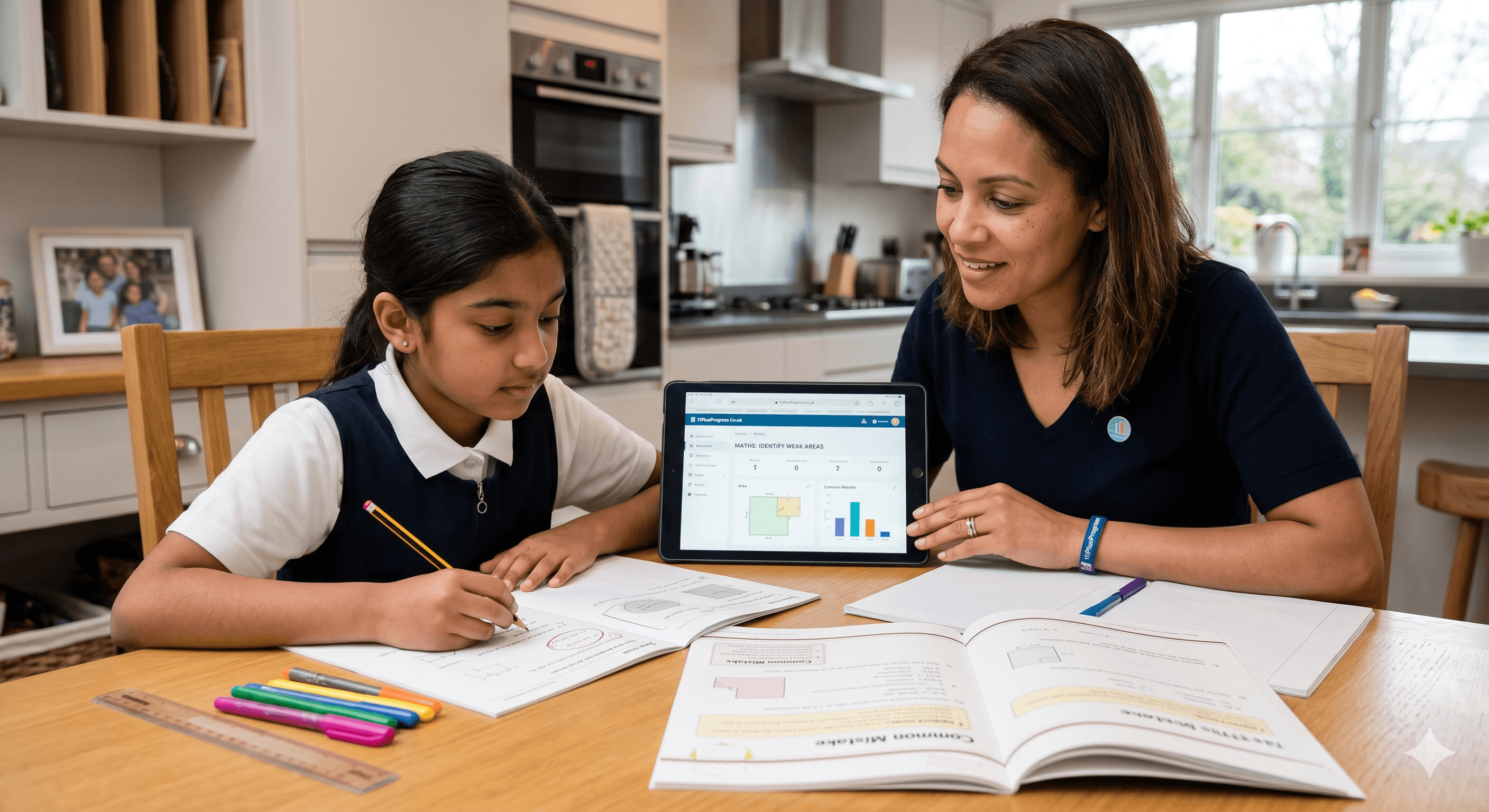
11+ Maths Topics: The Definitive Guide to Helping Your Child Succeed
The transition from primary school to a selective grammar or independent secondary school is often defined by the hurdle of the 11+ entrance examination. For parents across the UK, this period is marked by a quest for clarity amidst a sea of conflicting advice, varied exam boards, and an increasingly competitive academic landscape. At the heart of this challenge lies the mathematics paper—a test that doesn't just measure a child's ability to calculate, but their capacity to reason, their speed of thought, and their resilience when faced with unfamiliar problems.
Understanding the full range of 11+ maths topics is the first step in moving from a state of general anxiety to one of targeted, effective preparation. The syllabus is primarily rooted in the Key Stage 2 (KS2) National Curriculum, but the 11+ is famous for its "stretch" questions—topics typically reserved for Year 6 or even early Year 7 that are pulled forward to identify high-potential students. Whether your child is sitting an exam set by GL Assessment, CEM, or a school-specific independent paper, the core mathematical foundations remain consistent, yet the way they are tested can vary significantly.
Most parents don’t realise where their child is struggling until they see the results of a full-length mock exam, which can often be a disheartening experience. By then, valuable time may have been lost. The secret to a low-stress, high-success preparation journey is identifying these weak areas early and using structured, topic-based practice to build confidence step-by-step (11+ maths topics).
The 11+ Maths Landscape: GL vs. CEM and Independent Boards
Before diving into specific 11+ maths topics, it is essential to understand the "who" and "how" of the testing process. Currently, GL Assessment is the most widely used provider for grammar school entrance exams in England, following a significant shift by many regions back to this format for the 2023–24 and 2024–25 admissions cycles. CEM (Centre for Evaluation and Monitoring), while still used in some regions like Birmingham and Buckinghamshire, often focuses on "numerical reasoning," where maths is blended with logic and word-based problems.
The distinction is important because GL Assessment papers are often categorised into clear subject papers (English, Maths, Verbal Reasoning, Non-Verbal Reasoning), whereas CEM papers may be integrated. Furthermore, independent schools often set their own papers, which are notorious for having more "free-response" questions (where a child must show their working) rather than multiple-choice formats. Regardless of the format, the underlying "Number Fluency" and "Numerical Reasoning" remain the two highest priorities for any child.
| Exam Feature | GL Assessment | CEM / Numerical Reasoning | Independent Schools |
|---|---|---|---|
| Format | Mostly Multiple Choice | Multiple Choice or Standard | Often Standard (Show working) |
| Topic Coverage | Broad KS2 Syllabus | Logic and Arithmetic heavy | KS2 plus Year 6/7 extension |
| Timing | Strict (e.g., 50 questions in 50 mins) | Highly pressured sections | Longer, multi-step problems |
| Adaptive? | Usually Non-adaptive | Often non-adaptive (but some digital) | Non-adaptive |
Number and Place Value: The Foundation of the 11+
The domain of Number and Place Value is the bedrock of the 11+ maths topics. It encompasses a child’s ability to understand the magnitude of numbers, the relationship between digits, and the systems we use to represent them.
Large Numbers and Magnitudes
By the end of Year 5, a child should be comfortable with numbers up to at least ![][image1], and for the 11+, this often extends to ![][image2].
- The Concept: Understanding that each column in a number is ten times larger than the one to its right. Children must be able to read, write, order, and round these numbers with precision.
- The Example: "Write the number eight million, five hundred and ten in figures." The answer is ![][image3].
- Common Mistakes: The "Zero Trap." Students often miss placeholders. For the example above, a common incorrect answer is ![][image4] or ![][image5]. Another frequent error occurs in rounding—students may round to the nearest ![][image6] instead of the nearest ![][image7] because they misread the instructions.
Negative Numbers
Negative numbers represent values below zero and are a frequent feature in 11+ "context" questions, such as temperature or bank balances.
- The Concept: Counting backwards through zero. Children need to calculate the difference between a positive and a negative number.
- The Example: "The temperature in London is ![][image8] and the temperature in Moscow is ![][image9]. What is the difference between these temperatures?" The answer is ![][image10].
- Common Mistakes: Many students simply subtract the two numbers (![][image11]) rather than adding the distances from zero. They struggle with "stepping" through the zero point on a number line.
Roman Numerals
While it might seem archaic, Roman Numerals up to ![][image6] (![][image12]) are a standard part of the 11+ syllabus.
- The Concept: Using a system of letters to represent values, where the position of the letter determines whether you add or subtract (e.g., ![][image13]).
- The Example: "Convert the year ![][image14] into Roman Numerals." The answer is ![][image15].
- Common Mistakes: Forgetting the subtractive rules for ![][image16] and ![][image17]. Students often write ![][image18] for ![][image16] instead of ![][image19], or ![][image20] for ![][image21] instead of ![][image22]. They also struggle with larger values like ![][image23] (![][image24]) and ![][image25] (![][image26]).
The Four Operations: Precision and Speed
Arithmetic is where most "careless errors" occur. The 11+ demands not just the ability to find the answer, but to do so using the most efficient formal written methods.
Column Addition and Subtraction
- The Concept: Aligning digits in their respective place value columns and "carrying" or "exchanging" across columns.
- The Example: ![][image27].
- Common Mistakes: Misalignment of columns, especially when numbers have different amounts of digits. In subtraction, the "Borrowing from Zero" error is rampant; if a student needs to subtract from ![][image28], they often forget to reduce the preceding digits correctly.
Long Multiplication and Short Division
- The Concept: Short division (the "bus stop" method) and long multiplication for 2-digit numbers.
- The Example: ![][image29] or ![][image30].
- Common Mistakes: In multiplication, forgetting the "placeholder zero" when multiplying by the tens digit is the single most common reason for a lost mark. In division, students often ignore the remainder or fail to convert it into a fraction or decimal as required by the question.
Order of Operations (BIDMAS/BODMAS)
This is identified as one of the three most difficult topics for 11+ students.
- The Concept: The sequence in which a calculation must be solved: Brackets, Indices (Squares/Cubes), Division and Multiplication, Addition and Subtraction.
- The Example: ![][image31]. The correct answer is ![][image32] (![][image33], then ![][image34]).
- Common Mistakes: Treating it as a simple left-to-right list. In the example above, many students will calculate ![][image35], then ![][image36]. Another pitfall is treating Division and Multiplication as having different priorities, whereas they are actually on the same "level" and should be solved left-to-right within the same step.
Fractions, Decimals, and Percentages: The "FDP" Triad
Examiners consistently report that fractions, decimals, and percentages are the areas where candidates lose the most marks. These concepts require a child to think about numbers in a non-integer way, which is a major cognitive leap.
Fractions: The Core Concepts
11+ maths topics include ordering fractions, finding equivalent fractions, and performing all four operations on them.
- The Concept: Parts of a whole. Students must understand improper fractions (![][image37]) and mixed numbers (![][image38] and ![][image39]).
- The Example: "Which is larger: ![][image40] or ![][image41]?" The answer is ![][image40].
- Common Mistakes: The "Bigger Number" bias. Students assume that because ![][image42] is bigger than ![][image17], ![][image41] must be larger. They also frequently add the denominators when adding fractions (e.g., ![][image43] instead of ![][image44]).
Decimals and Percentages
- The Concept: Converting between these formats is a vital skill. ![][image45] is ![][image46] is ![][image47].
- The Example: "Find ![][image48] of ![][image49]."
- Common Mistakes: In decimals, misplacing the decimal point during multiplication (e.g., ![][image50] instead of ![][image51]). In percentages, students often struggle with "percentage increase or decrease"—for example, failing to add the ![][image48] back onto the original amount.
How to actually identify weak areas in these complex topics is the difference between a child who feels overwhelmed and one who feels prepared. Instead of guessing which worksheets to print, parents should look for tools that provide a "Topic Breakdown." This allows you to see, for instance, that your child is great at adding fractions but struggles with simplifying them. Targeted practice on that one sub-skill can raise a score by ![][image52] overnight.
Check your child's progress
Open the parent dashboard for topic breakdowns, history, and next steps after practice.
Check your child's progressRatio and Proportion: The Logic of Relationships
Ratio and proportion are "stretch" topics that test a child’s ability to scale numbers and understand relative quantities.
Understanding Ratio
- The Concept: A way of comparing quantities using the ":" symbol.
- The Example: "In a bag of sweets, the ratio of red to blue is ![][image53]. If there are ![][image54] red sweets, how many blue sweets are there?" The answer is ![][image55] (since ![][image54] is ![][image56], we must calculate ![][image57]).
- Common Mistakes: Reversing the ratio. If the question asks for "blue to red," students often give the "red to blue" answer. Another common error is dividing the total amount by one of the ratio numbers rather than the sum of the parts.
Proportion and Scaling
- The Concept: Understanding that if you double one side of a relationship (like a recipe), you must double the other.
- The Example: "A recipe for ![][image16] people uses ![][image58] of flour. How much is needed for ![][image59] people?" The answer is ![][image60].
- Common Mistakes: Additive thinking. Some students think "6 people is 2 more people, so I need 2g more flour." They fail to recognize the multiplicative nature of the problem.
Measurement: Time, Money, and Units
Measurement questions often seem "easy" but are designed to catch students out through unit conversions.
Metric and Imperial Units
- The Concept: Converting between ![][image61] and ![][image62] and ![][image63].
- The Example: "How many millimetres are in ![][image64] metres?" The answer is ![][image65].
- Common Mistakes: Mixing up ![][image66] and ![][image6]. Students often think there are ![][image67] grams in a kilogram or ![][image67] millimetres in a centimetre. This is a foundational gap that can ruin a child's chances in the measurement section.
The Time Trap
- The Concept: Calculating durations, reading 24-hour clocks, and interpreting timetables.
- The Example: "A train leaves at ![][image68] and the journey takes ![][image38] hour and ![][image69] minutes. What time does it arrive?" The answer is ![][image70].
- Common Mistakes: "Decimal Time." This is the most common mistake in 11+ maths. Students treat ![][image71] minutes as ![][image67] minutes. For the example above, a student might add ![][image72] and get ![][image73], then write the time as ![][image74] or round it to ![][image70] but make an error in the "carry over" because they aren't thinking in base-60.
Geometry: Shapes and Spatial Awareness
Geometry in the 11+ covers properties of 2D and 3D shapes, angles, symmetry, and coordinates.
Properties of Shapes
- The Concept: Knowing the difference between isosceles, equilateral, and scalene triangles; identifying parallelograms, rhombuses, and trapeziums.
- The Example: "How many faces does a triangular prism have?" The answer is ![][image75].
- Common Mistakes: Confusing "Regular" with "Irregular." A regular shape must have all sides and all angles equal. Many students think a rectangle is regular because it has ![][image76]-degree angles, forgetting that the sides are not all equal.
Angle Rules
- The Concept: Angles on a straight line (![][image77]), around a point (![][image78]), and inside a triangle (![][image77]).
- The Example: "Two angles in a triangle are ![][image79] and ![][image80]. What is the third?" The answer is ![][image81].
- Common Mistakes: Assumed Information. Students often look at a diagram and "guess" an angle is a right angle or that a triangle is isosceles because it "looks like it." Examiners deliberately draw diagrams "not to scale" to punish this habit.
Perimeter, Area, and Volume
- The Concept: Perimeter is the distance around the outside; Area is the space inside. Volume is for 3D shapes.
- The Example: "Calculate the area of a right-angled triangle with base ![][image82] and height ![][image83]." The answer is ![][image84] (![][image85]).
- Common Mistakes: Forgetting to divide by ![][image86] for triangles. In perimeter, students often forget to calculate "missing" sides in a compound shape (an L-shape). In volume, they often confuse surface area with total volume.
Statistics: Handling Data
Data handling involves interpreting charts, graphs, and tables, alongside calculating averages.
Mean, Median, Mode, and Range
- The Concept:
- Mean: Add all numbers and divide by the count.
- Median: The middle number in an ordered list.
- Mode: The most frequent number.
- Range: The difference between the highest and lowest.
- The Example: "Find the median of ![][image87]."
- Common Mistakes: Forgetting to order the numbers first. In the example above, a student might pick ![][image88] (the middle of the unsorted list) rather than ![][image75] (the middle of ![][image89]). Another mistake is confusing "Range" with an average.
Interpreting Graphs and Pie Charts
- The Concept: Reading scales on a bar chart or degrees on a pie chart.
- The Example: "A pie chart represents ![][image90] people. If the 'Science' sector is ![][image91], how many people chose Science?" The answer is ![][image76].
- Common Mistakes: Misreading the key in a pictogram (e.g., thinking one symbol equals ![][image38] person when it actually equals ![][image42]). In pie charts, students struggle with the relationship between the degree of the angle and the actual number of items.
Algebra: The "Stretch" Topic
While not always in every 11+ paper, basic algebra is increasingly common, particularly in independent school exams.
- The Concept: Using letters (variables) to represent numbers and solving simple equations.
- The Example: "If ![][image92], what is the value of ![][image93]?" The answer is ![][image94].
- Common Mistakes: Substitution Errors. Students often think ![][image95] when ![][image92] is ![][image96] rather than ![][image97]. They also struggle with "inverse operations"—for example, finding the value of ![][image98] in ![][image99].
Solving Word Problems: The Ultimate Test
The most difficult part of the 11+ isn't the maths itself—it's the reading comprehension required to find the maths within a word problem.
- The Challenge: A student might know how to divide, but can they spot that they need to use division in a paragraph about a baker sharing loaves of bread?
- The Strategy: Train your child to underline keywords like "total," "share," "each," "remaining," and "difference."
- Common Mistakes: Rushing and performing the first operation that comes to mind. If a question says "John has ![][image54] sweets and gives ![][image75] to Mary," students might just subtract. But if the question continues "...and then he doubles his remaining amount," they often stop after the first step.
Building the Right 11+ Study Habit
Understanding these 11+ maths topics is only half the battle. The other half is consistency. Most experts agree that starting preparation in Year 4 or early Year 5 is ideal, allowing for a "little and often" approach rather than a stressful cramming session in the final weeks.
| Preparation Stage | Focus Area |
|---|---|
| Early Year 5 | Mastering the basics (Times tables, FDP conversions) |
| Mid Year 5 | Introducing reasoning and word problems |
| Late Year 5 | Timed practice and speed work |
| Summer Term | Identifying and closing final knowledge gaps |
To avoid burnout, it’s crucial to track progress. A child who feels they are "bad at maths" usually just has a few specific gaps that, once closed, make the whole subject feel easier. Identifying these gaps early builds the resilience needed for the actual exam day.
Start Your Journey with 11PlusProgress
Preparation for the 11+ shouldn't feel like a second full-time job for you or your child. The key is structured practice—doing the right questions at the right time. By using 11PlusProgress, you can move away from the "scattergun" approach of generic workbooks and instead focus on the specific topics where your child can make the most gain.
Our platform is designed by 11+ specialists to mirror the exact types of questions found in GL and CEM exams. But more importantly, it gives you the data you need to be a supportive, informed parent. No more guessing. No more wasted evenings. Just clear, measurable progress.
Start your free trial of 11PlusProgress today and give your child the tools they need to master every 11+ maths topic with confidence. Our progress tracking and topic-based sets will help you identify weak areas instantly, ensuring your child is exam-ready and stress-free.
Start free
Create an account and begin structured 11+ practice. Free during public beta — see our Terms.
Sign up free